
Home » Spiders
Category Archives: Spiders
Mediterranea and Victoriana
A miscellany from the last couple of days. Firstly a female Southern Oak Bush-cricket Meconema meridionale from south London today, one of many seen. These bush-crickets were discovered in Britain in 2001 having spread north from the Mediterranean. This is an adult, and the wings are tiny, so it clearly didn’t arrive in Britain by flight. But bush-crickets are sometimes found on parked vehicles and are amazingly good at clinging on at speed. It’s conceivable that it made it to London by just clinging on to some cross-channel traffic.

Southern Oak Bush-cricket female
I don’t normally pay much attention to spiders when I’m on a survey but this big girl certainly grabbed my attention: 13 mm long and looking like the sort of thing you’d see imported in a bunch of bananas, not under a log in London. It turns out to be Steatoda nobilis, and true enough this species “has been repeatedly introduced from the Canary Islands and Madeira with bananas”! In the Harvey, Nellist and Telfer (2002) Atlas it only has four dots in Britain but a look at the latest map from the Spider Recording Scheme shows that it has made itself firmly at home in southern England in the last decade. It is obligatory to mention that this is a species which can inflict a painful bite if suitably provoked.

Steatoda nobilis female
Finally, a beetle I could reasonably have expected never to see my whole life long: Oxytelus piceus. It lives in cow-pats and would not have been an unexpected sight to a Victorian coleopterist living in southern Britain. But the progress of the 20th century was tough on many dung-feeding beetles and by 1994 Hyman and Parsons were only aware of records since 1970 from West Norfolk and Monmouthshire, and made it a Red Data Book species. In a cursory search, I’ve not been able to find any other records from recent decades. It wouldn’t be surprising if it hasn’t been recorded in recent decades – the dung fauna is not exactly making a come-back. The specimen in the photo is one of two found at a light-trap in cattle pasture in Cambridgeshire on Wednesday night. Not for the first time, I’m thinking why don’t I go out on mothing nights more often. The beetles can be really interesting (and it is certainly more fun than poking through cow-pats).
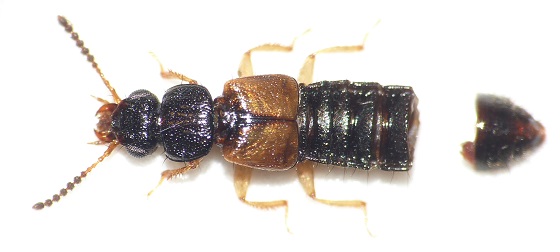
Oxytelus piceus male. Apical abdominal segments flipped to show the diagnostic coupling apparatus. Identifiable from the non-crenulate pronotal margins, constricted 1st antennal segment and large eyes.
My Ero
I caught a spider on the bedroom ceiling on Saturday and was about to chuck it out of the window when I noticed it had four pointy tubercles on its abdomen. There aren’t many spiders with abdominal tubercles so I thought I’d have a go at identifying it. Lucky I did as it turns out to be one of the pirate spiders Ero aphana – only the third record for Bedfordshire!

Ero aphana
The Atlas of British spiders (Harvey, Nellist and Telfer, 2002) lists about 11 sites for this species, all on the heathlands of Dorset, Hampshire and Surrey. It is still a Vulnerable (Red Data Book 2) species but since the turn of the millennium it has ceased to be dependent on heathland and has been turning up in a wide variety of mostly dry habitats (houses, gardens, brownfield sites, etc.) and spreading as far north as Nottinghamshire. Map and further info on the Spider Recording Scheme webpage.
Many thanks to Ian Dawson for helping to identify this spider and for information on its status in Beds.
A day in the life …
… of an entomological consultant. Yesterday was a pretty typical day, surveying a site which is proposed for development. I’m not able to reveal the location but it is a site with a mix of unmanaged grassland and secondary woodland. I spent a little over 6 hours in the field, concentrating my efforts on sweeping and beating. It almost goes without saying that I wore full waterproofs throughout though there was sunshine between the showers.
I worked yesterday evening and from early this morning to finish all the identification work and I’ve listed 102 species for the site. It is always my aim to record over 100 species from a day’s survey but I only just scraped over the line yesterday. I would expect more and I’m tending to agree with others who are saying that this is a poor spring for insects.
The list includes one Red Data Book species and five Nationally Scarce species, though, as is so often the case, some of these statuses are in need of revision for species which have become commoner and more widespread. But they are still useful species for assessing the conservation importance of the site.
I was really pleased to find the RDB hoverfly Rhingia rostrata: only the second one I’ve seen after Dave Gibbs showed me one last year. And there were two species which I got the camera out for. They’re just superb beasts and I don’t think I will ever get tired of seeing them!

Centrotus cornutus, a treehopper

Attelabus nitens, the Oak Leaf-roller
Coproporus immigrans is a recent arrival in Britain, specialising in woodchip piles, and I’d only seen it on two previous occasions before yesterday. Here it was in quite an old woodchip pile with thistles growing out of it, though it favours fresh woodchip.

Coproporus immigrans, a distinctive tachyporine rove-beetle
It’s not my aim on survey work to look for species I’ve never seen before: it’s about playing to my strengths and giving the client best value for money, rather than trying to get ticks. But I usually manage a few new species and yesterday I cut open a currant gall on oak for the first time to see the larva of Neuroterus quercusbaccarum within. Also, the common mirid bug Dicyphus globulifer was a new one for me, from a group which I’m tackling more seriously since I acquired Suomen Luteet.
| Species (scientific name) | Species (English name) | Conservation Status |
| Oniscus asellus | Common Shiny Woodlouse | None |
| Porcellio scaber | Common Rough Woodlouse | None |
| Nuctenea umbratica | a spider | None |
| Pisaura mirabilis | a spider | None |
| Glomeris marginata | Pill Millipede | None |
| Cylindroiulus punctatus | Blunt-tailed Millipede | None |
| Forficula auricularia | Common Earwig | None |
| Leptophyes punctatissima | Speckled Bush-cricket | None |
| Centrotus cornutus | a treehopper | None |
| Dicyphus globulifer | a mirid bug | None |
| Deraeocoris lutescens | a mirid bug | None |
| Liocoris tripustulatus | a mirid bug | None |
| Miris striatus | a mirid bug | None |
| Stenodema laevigata | a mirid bug | None |
| Harpocera thoracica | a mirid bug | None |
| Anthocoris confusus | a flower bug | None |
| Anthocoris nemorum | a flower bug | None |
| Kleidocerys resedae | a ground-bug | None |
| Pentatoma rufipes | Red-legged Shieldbug | None |
| Paradromius linearis | a ground beetle | None |
| Ptinella aptera | a featherwing beetle | None |
| Euplectus karstenii | a pselaphine rove-beetle | None |
| Tachyporus hypnorum | a rove-beetle | None |
| Coproporus immigrans | a rove-beetle | None |
| Stenus flavipes | a rove-beetle | None |
| Trixagus dermestoides | a beetle | None |
| Athous haemorrhoidalis | a click-beetle | None |
| Agriotes pallidulus | a click-beetle | None |
| Cantharis decipiens | a soldier-beetle | None |
| Rhagonycha lignosa | a soldier-beetle | None |
| Epuraea pallescens | a beetle | None |
| Meligethes carinulatus | a pollen beetle | None |
| Meligethes nigrescens | a pollen beetle | None |
| Byturus ochraceus | a beetle | None |
| Cerylon histeroides | a beetle | None |
| Rhyzobius litura | a ladybird | None |
| Exochomus quadripustulatus | Pine Ladybird | None |
| Propylea quattuordecimpunctata | 14-spot Ladybird | None |
| Coccinella septempunctata | 7-spot Ladybird | None |
| Cortinicara gibbosa | a beetle | None |
| Mycetophagus piceus | a beetle | Nationally Scarce (Nb) |
| Mordellochroa abdominalis | a tumbling flower-beetle | None |
| Nalassus laevioctostriatus | a darkling beetle | None |
| Ischnomera cyanea | a beetle | Nationally Scarce (Nb) |
| Oedemera lurida | a beetle | None |
| Pyrochroa coccinea | Black-headed Cardinal Beetle | Nationally Scarce (Nb) |
| Salpingus planirostris | a beetle | None |
| Anaspis frontalis | a beetle | None |
| Anaspis fasciata | a beetle | None |
| Anaspis maculata | a beetle | None |
| Bruchus rufimanus | a seed-beetle | None |
| Lochmaea crataegi | Hawthorn Leaf-beetle | None |
| Longitarsus luridus | a flea-beetle | None |
| Crepidodera aurea | a flea-beetle | None |
| Lasiorhynchites olivaceus | a weevil | Nationally Scarce (Na) |
| Tatianaerhynchites aequatus | a weevil | None |
| Attelabus nitens | Oak Leaf-roller | None |
| Aspidapion aeneum | a weevil | None |
| Protapion fulvipes | White Clover Seed Weevil | None |
| Protapion trifolii | a weevil | None |
| Perapion curtirostre | a weevil | None |
| Perapion hydrolapathi | a weevil | None |
| Apion frumentarium | a weevil | None |
| Ischnopterapion loti | a weevil | None |
| Phyllobius roboretanus | Small Green Nettle Weevil | None |
| Phyllobius pyri | Common Leaf Weevil | None |
| Sitona lepidus | a weevil | None |
| Magdalis armigera | a weevil | None |
| Rhinoncus pericarpius | a weevil | None |
| Ceutorhynchus typhae | a weevil | None |
| Ceutorhynchus obstrictus | a weevil | None |
| Trichosirocalus troglodytes | a weevil | None |
| Nedyus quadrimaculatus | Small Nettle Weevil | None |
| Anthonomus pedicularius | a weevil | None |
| Anthonomus rubi | a weevil | None |
| Curculio glandium | Acorn Weevil | None |
| Archarius pyrrhoceras | a weevil | None |
| Gymnetron pascuorum | a weevil | None |
| Neuroterus quercusbaccarum f. sexual | Currant gall causer | None |
| Biorhiza pallida f. sexual | Oak-apple causer | None |
| Lasius brunneus | Brown Tree Ant | Nationally Scarce (Na) |
| Lasius niger sens. str. | an ant | None |
| Myrmica rubra | an ant | None |
| Myrmica scabrinodis | an ant | None |
| Bombus hortorum | Small Garden Bumblebee | None |
| Bombus pascuorum | Common Carder-bee | None |
| Panorpa germanica | a scorpion-fly | None |
| Rhagio scolopaceus | Downlooker Snipefly | None |
| Beris chalybata | Murky-legged Black Legionnaire | None |
| Microchrysa polita | Black-horned Gem | None |
| Empis tessellata | a dance fly | None |
| Melanostoma mellinum | a hoverfly | None |
| Sphaerophoria scripta | a hoverfly | None |
| Rhingia campestris | a hoverfly | None |
| Rhingia rostrata | a hoverfly | RDB3 |
| Neoascia podagrica | a hoverfly | None |
| Syritta pipiens | a hoverfly | None |
| Tephritis neesii | a picture-winged fly | None |
| Anthophila fabriciana | Nettle-tap | None |
| Pieris rapae | Small White | LC |
| Pararge aegeria | Speckled Wood | LC |
| Monacha cantiana | Kentish Snail | None |
A weekend in the rainforest
Back when flights were cancelled all across Europe because of the Icelandic ash cloud, I went to the tropical rainforest for a weekend, and popped into the Mediterranean for a few hours on Saturday afternoon! Of course, I was at the Eden Project. Following a very interesting visit on 17th April 2009 with the British Myriapod and Isopod Group (BMIG), I arranged for a return visit on 17th-18th April 2010 for myself and Jo, along with Steve Gregory (woodlouse expert), Darren Mann and Clive Turner plus friends and partners.

The two biomes

In the Rainforest
You might say that studying the wildlife within a greenhouse is a trivial thing, and not nearly as interesting as studying the native wildlife outdoors. But for me this is about as close as I have come to my unattainable dream of being the first naturalist to step ashore on some undiscovered land, seeing species that no-one has laid eyes on before. And yes … I have seen undescribed species.
Identifying the species that I and others have found in the biomes at the Eden Project is a slow business, and I am reliant on the help of the top experts in Britain and abroad, whose time and expertise is greatly appreciated. This blog gives a summary of work-in-progress.
Thanks to Marc Mappley and colleagues for allowing us to study the invertebrates in the biomes.
The Rainforest Biome: Woodlice

Gabunillo

Gabunillo
Prior to the 2009 visit, only two species of woodlouse were known from the Rainforest Biome: the pill-woodlouse Venezillo parvus (discovered new to Britain from the Eden Project) and Trichorhina tomentosa (known from several other tropical glasshouses in Britain). Steve Gregory has now got records of a further 12 species detailed below: 4 aliens new to Britain (of which 2 new to science), 6 known glasshouse aliens, and only 2 native British species.
1. A species apparently new to science and probably in the genus Gabunillo. I found 13 (all females) of these small pill-woodlice on 17th April 2009, mostly in the bamboo litter of the Malaysia zone. Steve Gregory passed them onto world expert Stefano Taiti, who commented “Most probably a new species of Gabunillo Schmalfuss & Ferrara, 1983. The only species known in the genus, G. coecus, was described from some caves in Gabon. Your specimens differ in the lobes of the schisma and presence of the single reddish ocellus. For G. coecus males are known”. Several more were found in 2010 but although about 50 examples have been found so far, still no males. It may be a parthenogenetic species.
2. A species apparently new to science in the genus Pseudotyphloscia (a genus close to but distinct from Burmoniscus). Steve had 2 males of this philosciid from soil samples collected in the Rainforest Biome in 2004 and 2005 by the Natural History Museum and extracted by Tullgren funnel. He sent them to Stefano Taiti in March 2010 and Stefano commented: “This is a new species of Pseudotyphloscia Verhoeff, 1928. Up to now the genus includes only one species, P. alba (Dollfus, 1898) with a wide distribution in southern China, Taiwan, Indonesia and Philippines.” On our visit in 2010, Steve located this species in good numbers (including many males) associated with wooden pilings and shorings near the stream.

Pseudotyphloscia

unknown pill-woodlouse
3. An unknown pill-woodlouse new to Britain. I collected a single specimen on 18th April 2010. It is similar to ‘Gabunillo’ but smaller, yellowish, with dark tapered bristles (rather than colourless clubbed scales), with differently shaped outer margin to first pereonite, and with different uropods, excavated to accommodate an appendage. Steve and I would still like to get Stefano Taiti’s opinion on this one. However, Steve suspects it is just an immature Venezillo parvus.
4. Another philosciid species was collected by NHM in 2003 but just a single female and in a very poor state of preservation. It is coloured chocolate and white, 3.5 mm long. It may not even be possible to determine to genus but is something new to Britain.
5. Reductoniscus costulatus, a small bumpy pill-woodlouse, known from Kew Gardens since 1947. Common in the Rainforest Biome in 2009 and 2010, its second British locality. More recently, Steve has found two specimens from soil samples collected by the NHM in 2003 and 2005.
6. Agabiformius lentus. Once thought to be the most widespread alien woodlouse in British glasshouses, the 3 specimens I found in 2009 (det. SJG) were the first British records since before 1980.
7. Nagurus cristatus. Recorded from Northumberland in 1965 but not since (Gregory, 2009). I found 2 in 2009 and Darren found it in 2010 (all det. SJG).
8. Nagurus nanus. Steve had lots (males and females) of this species (identification confirmed by Stefano Taiti in March 2010) from samples collected by NMH in 2004 and extracted by Tullgren funnel. New to Britain but there is one Irish record of a single specimen from a heated glasshouse in Belfast Botanic Gardens in 1911.
9. & 10. On 17th April 2009, Helen Read found a female styloniscid woodlouse, possibly Cordioniscus stebbingi (det. S.J. Gregory). There is also a single female styloniscid from the NHM soil samples in 2004 which appears to be a different species. There are three styloniscids on the British list, all hothouse aliens. Males are needed to determine which, if any, of these are present in the Rainforest Biome. However, our visit in 2010 didn’t turn up any styloniscids.
11. & 12. In 2009 I found a few specimens of Haplophthalmus danicus near the edge of the Rainforest Biome. This is a common pygmy-woodlouse outdoors in Britain. The NHM samples also contained Armadillidium nasatum, a common greenhouse species in Britain but also fairly widespread outdoors.
The Mediterranean Biome: Woodlice

Armadillidium ?assimile?

Chaetophiloscia sicula

Lucasius pallidus
The Mediterranean Biome is not quite so well-stocked with exotic invertebrates but in 2005, Tony Barber recorded three species of woodlouse, two of them new to Britain: 8 females of an Armadillidium sp. new to Britain (males needed for identification), a single female ?Chaetophiloscia? (again, males needed) and Porcellio scaber (perhaps the commonest British woodlouse; also present in 2010).
In 2010, Steve Gregory was keen to try and find males of the Armadillidium and the ?Chaetophiloscia? He succeeded in finding a male of the Armadillidium which he has provisionally identified as A. assimile.
Steve’s searches also turned up an unfamiliar porcellionid which he identified within the week as Lucasius pallidus, new to Britain, a woodlouse of Mediterranean France and Spain.
Steve kindly showed me the spot where he’d found what turned out to be Lucasius pallidus, and by heaving over a large and deeply-embedded rock, I found some of the ?Chaetophiloscia?, including a single adult male. I have confidently identified this as C. sicula but will get Steve to check it in due course.
Millipedes
The Rainforest Biome had been better worked for millipedes prior to the 2009 BMIG visit, with five species recorded, including the superb Paraspirobolus lucifugus which was discovered new to Britain from the Eden Project and was common in 2009 and 2010.

Amphitomeus attemsi and 2 Reductoniscus costulatus
I didn’t pay as much attention to millipedes as I did to woodlice on the 2009 visit (nor the 2010 visit for that matter) but I did find 12 specimens of a tiny white pill-millipede that seemed likely to be new to Britain. Helen Read also found one on that visit and quickly pinned it down as Amphitomeus attemsi, new to Britain (Barber et al., 2010).

Siphonophorida sp.

close-up of horn
Better was to come in 2010 though when I found a single small, white millipede by digging down at the side of some damp, rotting, wooden pilings. Now I love the instant thrill of discovering a rarity that you instantly recognise, like the Bee-eater that came and flew about overhead one fine June day on the Deal sandhills. But I also love the feeling of staring at an invertebrate in a state of complete bafflement. Under the microscope, this millipede was like nothing I’d ever seen and after consulting every book in my possession and googling everything I could find, I was still not even entirely sure it was a millipede! Description here. Fortuitously, Helen Read recognised it as a millipede of the Order Siphonophorida, a pantropical group in which she is something of an expert. This is a new Order for Britain, and maybe a new Order for Europe! Unfortunately, they are a taxonomist’s nightmare and the chances of being able to identify my specimen to species are very small. No-one knows what they feed on or what the narwhal-like head-spike is for.
Cylindrodesmus hirsutus is a millipede known from the Palm House at Kew and from a tropical butterfly house in South Yorks as well as from the Rainforest Biome. This and/or a comparable species were found in 2009 and 2010: whitish specimens lacking paranota which seem to be C. hirsutus as well as pinkish-terracotta coloured specimens with distinct paranota which seem to be a different species. Steve is trying to figure this out with advice from Henrik Enghoff.
Anthogona brittanica is an outdoor millipede, described new to science from a male specimen collected at Slapton Ley, South Devon by Steve Gregory in 1993 (Dick Jones had also collected a specimen there in 1983) and still believed to be a British endemic. Lee (2006) mapped it from four contiguous 10-km squares of South Devon. I collected one specimen in 2009 near the edge of the biome and although it is a female, it is probably A. britannica (Steve Gregory, who described the species, tentatively agrees!). It would be good to find a male and clinch this as it would be a significant record of a rare, endemic invertebrate.
Of the three other species known from the Rainforest Biome prior to 2009, Oxidus gracilis was fairly common in 2009 and 2010 but neither Poratia digitata nor Rhinotus purpureus was seen. Later in 2009, after the BMIG visit, Tony Barber discovered Pseudospirobolellus avernus new to Britain and in fact a new family (Pseudospirobolellidae) to Europe (Barber et al., 2010). There is some evidence that species in the biomes change in abundance and it is possible that some have established only temporarily and now died out.
Beetles
Disappointingly, there are very few beetles in the Rainforest Biome. In fact, I have only found two species, though one is quite an unusual species: the silvanid Cryptamorpha desjardinsii (common in 2009 but less so in 2010). The other was Harpalus rufipes, a very common carabid beetle.
I have found several species of beetle in the Mediterranean Biome but all are common species of outdoor habitats in Britain.
Other invertebrates

A short-tailed whip-scorpion Schizomida sp.
There are lots of other invertebrates in the biomes, and with the need to screen everything carefully as a potential new to Britain or even new to science, it is quite difficult to record across all groups. However, some of the highlights are:
- Australian Cockroach Periplaneta australasiae
- Surinam Cockroach Pycnoscelus surinamensis
- a jumping spider Hasarius adansoni
- a short-tailed whip-scorpion Schizomida sp.
- 5+ species of ants including Hypoponera punctatissima
- big earwigs, probably a species new to Britain
- 4 known species of centipede: Mecistocephalus guildingii, Tygarrup javanicus, Cryptops doriae and Lamyctes caeculus.
- several species of snail including Subulina octona and Striosubulina ‘striatella’
There’s sure to be a lot more to be found, and I know there’s a lot more still to be identified from Darren and Clive’s samples. It would be interesting to have a look round the biomes at night!
Reference
Barber, T., Gregory, S. and Lee, P. (2010). Reports on the 2009 BMIG Spring Meeting in Cornwall. Bulletin of the British Myriapod and Isopod Group, 24, 65 – 74.
Recent Comments